Picture this: you're at the counter, holding two eighths. Both say 24% THC. One costs ten dollars less. Which one do you trust? The honest answer starts with the label, but it doesn't end there.
The short version: a cannabis label is the summary, and the COA (certificate of analysis) is the lab report behind it. To check a product, match the batch number, confirm an independent lab ran the test, redo the total THC math yourself, and make sure every contaminant panel shows a pass. The rest of this guide shows you how, step by step, with no chemistry degree required.
Label vs COA: two documents, two jobs
Think of the label as a restaurant menu and the COA as the kitchen inspection report. The menu tells you what the place says it's serving. The inspection tells you whether the kitchen backs it up.
The label sits on the package. It's short, and regulators require it to carry specific facts: what the product is, how much THC and CBD it contains, and a set of warnings. The COA is a longer lab report from a third-party testing lab. It shows the cannabinoid profile and the results of safety testing for things like pesticides, heavy metals, mold and leftover solvents. New Jersey's regulators, for example, describe it as the document that details a product's safety, quality and potency.
You need both because neither works alone. A label can't fit a full lab report on a package the size of your palm, and a COA is meaningless if you can't connect it to the jar in your hand. The link between them is the batch (or lot) number.
| Label | COA | |
|---|---|---|
| Where it lives | On the package | Online, via QR code, or from the shop or brand |
| Length | A few lines | Usually several pages |
| What it answers | What is this, and how strong does it claim to be? | What did a lab actually find in this batch? |
| Biggest limit | It's a claim, not proof | It only covers the batch it was run on |
How to read a cannabis product label
Rules vary by state, but most legal markets ask for the same core facts. We'll use Washington as a concrete example, since its regulator publishes a clear consumer guide to reading labels. Check your own state's rules before you assume anything below applies where you shop.
Potency: percentages vs milligrams
The format depends on the product.
- Flower, pre-rolls and concentrates list potency as a percentage. Washington's regulator says most flower lands between 12% and 25% THC, while concentrates generally run 60% to 90%.
- Edibles list THC in milligrams, per serving and per package. Washington caps edibles at 10 mg of THC per serving and 100 mg per package, but other states set different limits.
Pre-rolls sometimes show milligrams instead of a percentage. To convert, divide the THC milligrams by the weight in milligrams. A 0.5 g pre-roll (500 mg of material) that lists 75 mg of total THC works out to 75 ÷ 500 = 15%.
Edibles also behave differently from smoked flower. Washington requires a warning that effects may be delayed by two hours or more, and our onset and duration guide explains why.
Total THC vs plain THC
Most labels show total THC. That figure accounts for THCA, the raw acid form in the plant that turns into THC when heated. If you see THC and THCA listed separately, the small THC number alone isn't the whole story. We'll do the math in a minute.
The rest of the label
- Product name, type and weight. The name usually points to the strain or product line.
- Warnings. Expect statements like "may be habit forming," a note that driving under the influence is illegal, and a "not for kids" symbol with a poison control number.
- Universal symbol. It marks regulated THC products. But Washington's regulator notes that some illicit sellers copy it, so treat it as a clue, not proof. Where the product is sold matters too.
- Ingredients and allergens on edibles, plus a statement about the extraction method and any solvents on concentrates.
- Batch or lot number, or a state tracking ID. This is the thread that ties the package to its COA.
- Dates. In Washington, best-by, harvest and manufacture dates are optional, so a missing date isn't automatically a red flag. A visible one is still a useful freshness hint.
Want the science behind the cannabinoids on that label? Our guide to THC, CBD, CBG and CBN covers it.
Where to find the COA for your product
The good news: you rarely have to hunt for long. Try these in order.
- Scan the QR code or follow the web link on the package. Washington, for instance, requires producers to make certain product information available through a link or QR code, and some markets use tracking systems like Metrc's Retail ID, which puts the COA behind a scan.
- Check the brand's website or the dispensary's online menu. Many brands post COAs by batch number.
- Ask the budtender. Something as simple as "Can I see the COA for this batch?" works. In Washington, shoppers can request the name of the certified lab and the test results from the retailer. A shop confident in its products should be able to pull it up.
If you can't find a COA anywhere, don't panic, but don't skip the question either. Requirements differ by state, and a missing report is a good reason to ask more questions or pick a different product.
One habit worth building: when you find a product you like, screenshot its COA with the batch number visible. Batches vary, so that screenshot becomes your reference the next time the same product name sits on the shelf.
Anatomy of a COA, section by section
Open a COA for the first time and it can look like a chemistry exam. It isn't. Almost every report follows the same order, and each section answers one question.
| Section | What it shows | What to check |
|---|---|---|
| Header | Lab name and contact, batch and sample IDs, product type, collection and test dates | Batch number matches your package; the lab is not the brand itself; the dates make sense |
| Cannabinoid profile | THC, THCA, CBD, minor cannabinoids, and calculated total THC and CBD | Total THC matches the label, and the math adds up (next section) |
| Terpenes (optional) | Aroma compounds and their concentrations | Real values, not just a list of names; many states don't require this panel |
| Pesticides | Residues measured against state limits | Pass, or ND, with limits shown |
| Heavy metals | Lead, arsenic, cadmium, mercury | Under the limit |
| Microbials and mycotoxins | Yeast, mold, bacteria, aflatoxins | Pass; which tests are required varies by state |
| Residual solvents | Leftover extraction solvents such as butane or ethanol | Matters for concentrates and vapes, not plain flower |
| Moisture | Water content, sometimes labeled loss on drying | Tells you whether potency is reported on a dry-weight basis |
Why so many contaminant panels? Cannabis can absorb what's in its soil and surroundings, which is why labs test for pesticides, metals and mold. The panels aren't decoration. They're the safety half of the report.
Decoding the abbreviations
- ND: not detected.
- LOD (limit of detection): the smallest amount the instrument can detect.
- LOQ (limit of quantification): the smallest amount it can measure accurately.
- <LOQ or BLQ: something may be present, but too little to measure reliably.
- mg/g: milligrams per gram. 10 mg/g equals 1%.
One caution: which panels a lab has to run is decided state by state. A COA that skips a test may simply be following local rules, but it's still worth noticing what the report doesn't cover. The Cannigma's COA guide makes the same point about aflatoxin and microbial limits differing across states.
Check the math: total THC in 30 seconds
Most flower isn't heated before it's tested, so the lab measures two things: THC, which is already active, and THCA, the raw acid that becomes THC when you smoke, vape or cook. The "total THC" on a label is a calculation, and you can verify it with a phone calculator.
Why 0.877? When THCA turns into THC it loses a small carboxyl group, so it ends up lighter. The factor reflects that weight difference, and labs such as SC Labs print the same formula on their reports.
A worked example
A flower COA lists 22.4% THCA and 0.6% Δ9-THC.
- Multiply the THCA: 22.4 × 0.877 = 19.64
- Add the THC that's already active: 19.64 + 0.6 = 20.24
- Total THC: about 20.2%
A common slip is adding the two numbers directly (22.4 + 0.6 = 23.0%). That overstates potency by nearly three points. If a label's total looks high next to the COA's THCA line, redo the math before you trust it.
Turning percent into milligrams
One percent equals 10 mg per gram, so 20.24% is about 202 mg/g. In a 3.5 g eighth, that's roughly 708 mg of total THC. Treat that as a theoretical ceiling. Real-world conversion when you burn or heat flower is never perfect.
One more detail worth knowing: the Colorado study we cover next measured potency as total THC by dry weight. If a COA reports on an as-received basis instead, water content will make the number look lower.
Can you trust the THC number? What the research says
Here's the part the industry doesn't love saying out loud: the THC percentage on a label is not always as precise as it looks.
In 2023, researchers from the University of Northern Colorado and Mile High Labs published a peer-reviewed study in PLOS ONE called "Uncomfortably high." They bought 23 flower samples from 10 Colorado dispensaries and tested them with HPLC, a standard lab method. Coverage of the study reports that:
- The average measured potency was 14.98%.
- About 70% of samples came in more than 15% below the number on the label.
- Three samples held only about half of the maximum potency claimed.
Two caveats before anyone panics. It was a small sample, from one state, in one study. It shows a pattern worth knowing about, not a verdict on every product.
Why would labels run high?
The study notes that flower prices often depend on THC potency, which gives sellers a reason to want big numbers. That's the backdrop for what the industry calls lab shopping: producers sending product to whichever lab returns the most flattering results. Industry voices say it's a real concern in several states, and lawsuits in Arkansas and California allege that some companies and labs overstated THC content. Those are allegations, not findings, but they show regulators and consumers are paying attention.
What that means when you shop
- Treat THC as a range, not a promise. A product labeled 26% and another labeled 24% may not be meaningfully different.
- Don't pay a big premium for a couple of points. Freshness, aroma and your own experience tell you more.
- Look for the complete COA, not just a potency line. Contaminant panels and terpene data show a brand is willing to be checked.
- Remember that higher isn't automatically better. Very high potency can feel overwhelming, and our guide to cannabinoids explains why other compounds matter too.
The 60-second COA check
You don't need to audit every number. Run these six checks and you'll catch most problems.
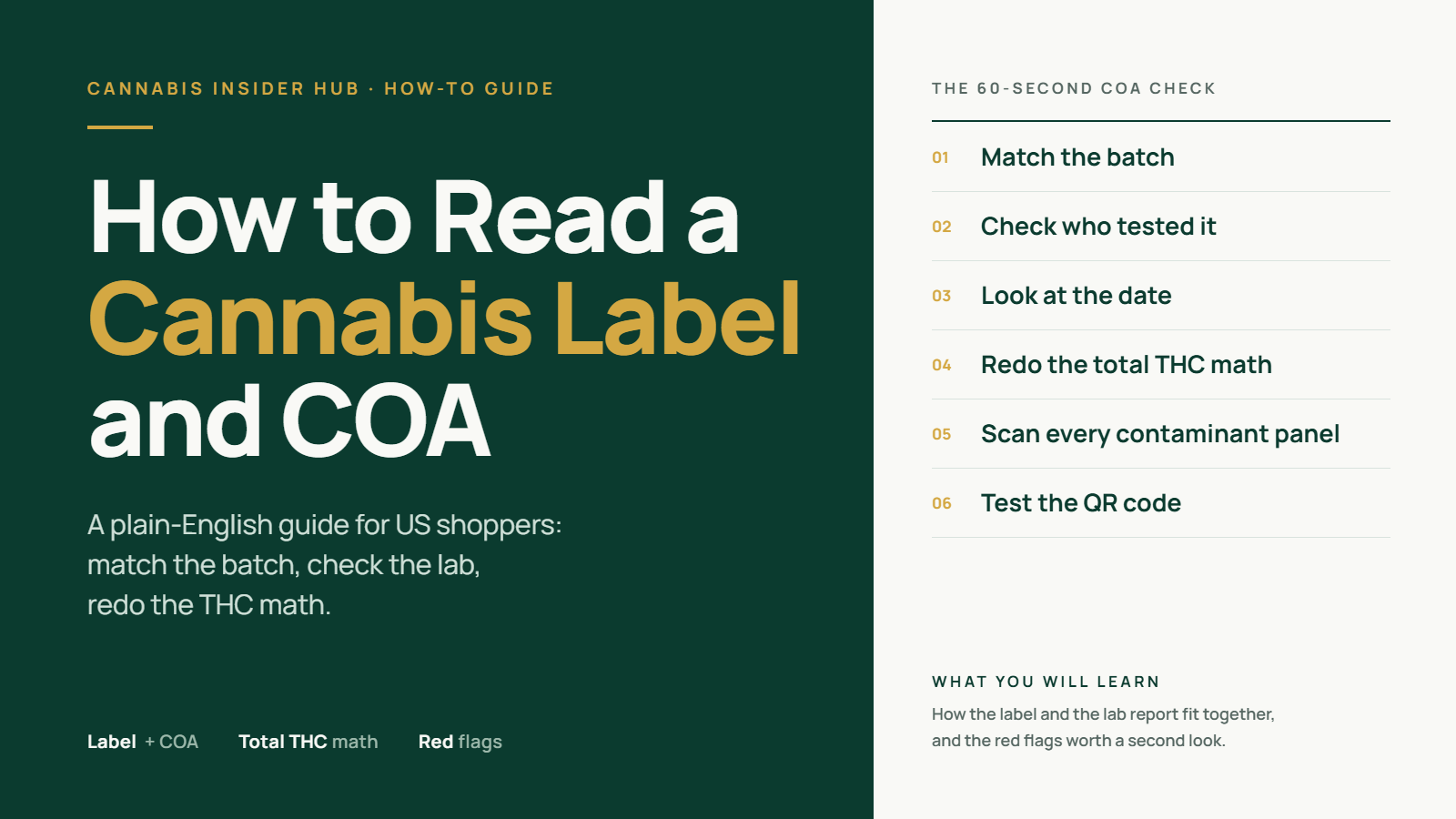
- Match the batch. The batch or lot number on the COA must match the one on your package. If it doesn't, the report is about a different product.
- Check who tested it. Look for a lab name and contact details, and make sure the lab is independent of the brand. Accreditation to ISO/IEC 17025, the common standard for testing labs, is a good sign.
- Look at the date. There's no universal expiry. Consumer guides suggest anywhere from six to twelve months, and your state may set its own rule. Fresher is better.
- Redo the total THC math. Use the formula above and compare it with the label.
- Scan every contaminant panel. Pesticides, metals, microbials and, for concentrates, solvents should each be present and passing.
- Test the QR code. It should open the report for your batch, not a homepage or a dead link.
Red flags worth a second look
None of these proves a product is bad on its own. Together, they're a reason to ask questions.
- No lab name, address or contact details on the report.
- A missing or mismatched batch number, or a generic COA that isn't tied to any batch.
- A QR code that goes nowhere or lands on a marketing page.
- Suspiciously round potency numbers, like exactly 30.00% batch after batch. Real results have decimals and drift.
- Contaminant results that read "ND" for everything on every batch, with no detection limits shown.
- Whole panels missing, or entries marked "not tested."
- A COA that's only a screenshot or image rather than a proper lab document.
Found something odd? Ask the shop or the brand first. A good seller will explain it, and the lab named on the report can often confirm whether a document is genuine if you give it the batch number.
What a COA can't tell you
A COA is a strong tool, but it isn't a guarantee. Keep these limits in mind.
- It covers a sample, not every bud or gummy. The report describes what the lab received from that batch.
- It goes stale. Cannabis changes with air, light and time. Washington's regulator notes that a COA won't stay accurate forever.
- It doesn't list everything in the product. A report only covers the compounds and contaminants it tested for.
- It can't predict how you'll feel. Cannabinoid and terpene numbers are useful clues, but people respond differently, and the research on how these compounds combine is still developing.
- It's only as good as the tests run. A report that covers potency alone is a label with a lab's logo on it, not a safety check.
This guide is educational, for adults 21 and older where cannabis is legal. It isn't medical or legal advice, and rules vary by state. If you use cannabis for a health reason, talk to a clinician who knows your history.
Frequently asked questions
What does COA stand for in cannabis?
COA stands for certificate of analysis. It's a lab report from a third-party testing lab that shows a batch's cannabinoid content and the results of safety tests such as pesticides, heavy metals, mold and residual solvents.
Does every cannabis product come with a COA?
In licensed markets, products are generally lab-tested before sale, and the results are documented in a COA. New Jersey, for example, requires testing by a licensed third-party lab. But what must be published, and how easy it is for shoppers to see, varies by state. When in doubt, ask the retailer for the batch's COA.
What's the difference between THC and total THC?
THC is the active form already present in the product. Total THC adds the potential THC from THCA, which converts when heated. The formula is Δ9-THC + (0.877 × THCA). Labels usually show total THC because that's the potency you can expect after heating.
How old can a COA be?
There's no single rule. Consumer guides commonly suggest a test date within six to twelve months, and your state may have its own requirements. Newer is better, and a COA should always match the exact batch you're holding.
What does ND mean on a COA?
ND means "not detected." The lab didn't find that compound at or above its detection limit. It doesn't mean the compound is impossible to find with a different method, so look for the listed limits too.
How can I tell if a COA is real?
Start with the batch number, then check the lab's name and contact details and test the QR code. If something still looks off, contact the lab listed on the report with the batch number and ask whether it issued the document.
Is higher THC always better?
No. Higher numbers mean a stronger product, not necessarily a better one. As the Colorado study shows, labeled potency can also be higher than what's actually in the package, so treat small differences between products with caution.